
ISSN: 0000‑0000
Volume 1, Issue 1 (2026)
Editorial Board
Peer‑review policy
Ethics & malpractice statement
Planetary Ethics and
Biodiversity Accounting Journal
NET Africa
Boulevard du Regent 54
PO Box 307
B-1000 Bruxelles
Belgium
Research Paper No. 2026/001
Is there a regeneration crisis? SEEA Species Accounts for Adansonia digitata in Benin: Implications for Africa
Abstract
This pilot study evaluated whether natural regeneration can sustain the existing Adansonia digitata population through the end of this century. The study examined the species’ spatial distribution, population structure, and regeneration status across Benin, West Africa. This national‑scale approach enabled a comprehensive assessment of how rainfall variability, agricultural expansion, and protected‑area coverage influence the species’ current and future viability.
Using 300 georeferenced citizen‑science photographs representing individual trees, the study applied the System of Environmental‑Economic Accounting (SEEA) Species Accounts framework—specifically stock, condition, reproduction, pressure, and ecosystem accounts—to produce the first experimental SEEA species account for A. digitata. Spatial data processing and species distribution mapping were conducted in QGIS 3.44.11, while Python 3.14, implemented through Visual Studio Code, supported data organisation, analysis, and visualisation.
The pilot study demonstrates that SEEA Species Accounts, combined with citizen‑science observations, offer a standardised, cost‑effective, and spatially explicit method for monitoring population status, regeneration dynamics, and long‑term conservation prospects of culturally and ecologically important tree species. These results provide a strong foundation for a full‑scale investigation into the regeneration capacity and future persistence of Adansonia digitata in Benin and across Africa.
Keywords: Adansonia digitata, Species, Regeneration, Africa

Fadeke Ayoola, FCCA
Environmental & Biodiversity Accounting Specialist
Fellow, Chartered Certified Accountant (FCCA)
Lead Environmental Auditor (ISO 14001:2015)
CEO, NET Africa
Citation
Ayoola, F. A. (2026). Is there a regeneration crisis? SEEA species accounts for Adansonia digitata in Benin: Implications for Africa. Journal of Planetary Ethics and Accounting, 1(1), 1–21. DOI: https://doi.org/xxxxx. Status: In press
© 2026 F. A. Ayoola. This work is licensed under a Creative Commons Attribution–NonCommercial–NoDerivatives 4.0 International License (CC BY‑NC‑ND 4.0).
Users may share the work with proper attribution, but may not use it commercially or create derivatives.
1. Introduction
This pilot study is the first experimental, documented global attempt to construct a SEEA-aligned species account for the African baobab, Adansonia digitata. Existing SEEA pilots focus almost exclusively on birds, mammals, and selected threatened species. No national statistical office or research institution has produced a spatially explicit, condition-integrated species account for Adansonia digitata or any African tree species. Adansonia digitata qualifies as a Class A biological asset because its products are commercially recoverable, rural communities actively use its populations, and its harvest contributes directly to household income, women’s cooperative development, and local poverty alleviation. By demonstrating how a culturally significant, climate-resilient keystone species can be incorporated into the System of Environmental and Economic Accounting (SEEA) framework, this work addresses a critical scale and monitoring gap in species accounting. It provides a replicable template for African governments seeking to integrate iconic species into natural capital accounting. It also addresses a critical decision-support gap, as SEEA species accounts provide condition-based information on species responses that can inform biodiversity management and climate-change scenario planning.
Background
The evolutionary legacy of Adansonia digitata has contributed to its longevity, drought tolerance, and ability to persist in nutrient-poor soils, reflecting evolutionary strategies suited to highly variable climatic conditions (Mayne et al., 2022). However, contemporary genetic research confirms that land-use fragmentation and the isolation of remnant adult trees increasingly compromise this genetic resilience (Omonhinmin et al., 2023; Cheptou et al., 2017; Nazrin et al., 2025; and Hendre, 2025). Increasing regeneration failure and the collapse of the African straw-coloured fruit bat pollination networks have also heightened the urgent need for conservation due to hunting pressure, roost disturbance, and habitat loss (Peel et al., 2017; Monadjem et al., 2016; Rainho, 2020). Eidolon helvum, the African straw-coloured fruit bat, is listed as “Near Threatened” on the IUCN Red List, indicating that the species is close to qualifying for a threatened category such as “Vulnerable”. Research estimates a 25–30% population loss over the past 15 years. (Cancino, 2024; Cooper-Bohannon et al., 2020; Webala, 2012; Mickleburgh et al., 2008; IUCN, 2011; Magloire et al., 2018; Singh, 2023). The IPBES global pollinator assessment, together with subsequent syntheses (Potts et al., 2016; Dicks et al., 2021; Stout and Dicks, 2022; Sadafale et al., 2025; Siviter et al., 2023; Kluser and Peduzzi, 2007; Thomann et al., 2013; Brunet and Fragoso et al., 2024; Feuerbacher, 2025; Kremen and Ricketts, 2000), documents widespread declines in pollinator abundance, diversity, and distribution across continents. These declines are primarily driven by habitat loss, pesticide exposure, climate change, and agricultural intensification, all of which may further exacerbate genetic isolation and reduce reproductive success in long-lived, pollinator-dependent species such as the African baobab (A. digitata).
Context
Adansonia digitata is an ecologically, culturally, and economically important species whose condition is influenced by environmental conditions and anthropogenic pressures (Adesina & Zhu, 2022). Its phenological cycles—including leaf emergence, flowering, and fruiting—are closely linked to rainfall and temperature regimes, making phenology a potentially valuable indicator of environmental variability and species condition (Venter & Witkowski, 2019). Changes in population structure, regeneration, and phenological patterns can provide insights into broader changes in ecosystem health, resource availability, and community resilience. The species faces multiple pressures, including land-use change, habitat degradation, harvesting, fire, grazing, and increasing climatic variability. Emerging evidence of regeneration constraints in parts of West Africa highlights the need for systematic monitoring of population distribution, condition, and the pressures affecting the species. However, assessing these dimensions consistently across large areas remains challenging because species observations are spatially uneven, condition indicators are not routinely integrated with distribution data, and information on pressures is often fragmented. Advances in citizen-science platforms, remote sensing, and geospatial technologies offer new opportunities to address these monitoring challenges by generating spatially extensive data on species occurrence, condition, phenology, and environmental pressures (Barnard et al., 2017; Gallagher et al., 2025; Conrad & Hilchey, 2011; Maxwell et al., 2020). Integrating these data into the SEEA framework can transform disparate observations into a structured species account that supports assessment of environmental change, identification of key threats, and evidence-based conservation and climate-change planning.
Trends
Ecological trends reveal a population structure dominated by mature individuals (Fischer et al., 2020; Venter & Witkowski, 2013), a pattern that is particularly concerning given the escalating threats faced by Eidolon helvum, one of the tree’s main pollinators. Over the past decade, systematic persecution of the African straw-coloured fruit bat has intensified, driven by entrenched cultural superstitions that portray these animals as harbingers of calamity and compounded by widespread concerns about their perceived role as viral reservoirs (Cancino, 2024). As E. helvum encounters these threats across multiple countries, the cumulative pressures place the species at increasing risk. Environmental trends point to intensifying climatic and anthropogenic pressures on dryland ecosystems, with Adansonia Digitata responses increasingly functioning as early-warning signals of broader biodiversity stress. Data trends reflect the rapid expansion of georeferenced citizen-science observations and high resolution remote imagery, enabling more spatially explicit and temporally resolved assessments of species condition and distribution. Monitoring trends indicate an emerging need to integrate species-level information into natural capital accounting frameworks, such as the SEEA, to support more systematic, repeatable, and policy-relevant biodiversity monitoring.
Objectives
The overall aim of this study is to assess whether natural regeneration is sufficient to replace the existing and future Adansonia digitata population. The study is guided by three core research questions: (i) How can climate-scenario models for Adansonia digitata be strengthened to represent its most likely ecological responses under future climate conditions? (ii) What are the major environmental and anthropogenic threats affecting Adansonia digitata in Benin, and how do these pressures influence its population condition, regeneration, and long-term persistence? (iii) What cost-effective conservation and management strategies can address these threats while maintaining viable populations and conserving the genetic diversity of Adansonia digitata?
Contribution to the Field
This study provides the first structured SEEA Species Accounts of Adansonia Digitata populations in Benin and the first global example of a SEEA-aligned species accounting for an African tree. It demonstrates how culturally significant, climate-resilient species can be integrated into natural capital accounting and offers a replicable methodology for other African countries. By combining social, spatial, and ecological evidence, the study delivers new insights into regeneration dynamics, pollination dependencies, and ecological vulnerability. It establishes an empirical foundation for linking Adansonia Digitata condition to ecosystem resilience and provides practical guidance for biodiversity management, policy development, and long-term monitoring.
2. Key Threats and Solutions
In this review of literature, a discussion of the key threats currently facing A. Digitata and the solutions to address these challenges are arranged around the key research questions. Firstly, a brief introduction to the history of the species. Adansonia digitata has historically exhibited substantial genetic diversity, enabling it to withstand environmental challenges such as drought, heat and disease, and to persist over many centuries (Stange, Barrett & Hendry, 2021; Des Roches et al., 2021; Mable, 2019). This genetic variation reduces extinction risk because populations are not uniformly vulnerable to the same threats (Stange et al., 2021). Moreover, A. digitata shows strong local adaptation across its range, evolving traits suited to specific environmental conditions (Ellegren & Galtier, 2016; Scotti et al., 2016).
However, genetic resilience alone does not guarantee long-term persistence if the environmental conditions that support the species begin to shift. Across Sub-Saharan Africa, climate-driven species distribution models increasingly project a contraction of A. Digitata habitat, particularly in regions experiencing intensifying aridity and altered rainfall seasonality (Assogba et al., 2022; Chitungo et al., 2022; Atakpama et al., 2023; Gadallah et al., 2025; Amevivi et al., 2025; Tagliari et al., 2021). These continental-scale trends highlight growing uncertainty about where suitable conditions will remain stable in the future. Within this broader pattern, Benin occupies a critical transition zone between humid southern ecosystems and the drier northern savannas, an area where climatic suitability may be maintained, reduced or fragmented depending on future scenarios. This raises a key question: to what extent will environmentally suitable conditions for Adansonia digitata in Benin persist under future climate change, and how can observed changes in the species’ distribution be used to evaluate and refine these projections?
Recent research indicates that the Benin landscape currently provides highly suitable environmental conditions for Adansonia digitata. Moreover, projections from Assogba et al. (2022) suggest that these areas of environmental suitability are likely to remain largely stable under future climate scenarios. However, other studies using similar climate scenarios point to a gradual contraction in the suitable climatic range of A. digitata. Chitungo et al. (2022) projected that, under future climate change scenarios, only a small proportion of the species’ current distribution across Africa will retain suitable environmental conditions. The remaining suitable habitats are expected to be concentrated primarily in Malawi and Mozambique, with smaller refugial areas occurring in Benin, Senegal, Burkina Faso, Zimbabwe, Botswana, Tanzania, and Madagascar. Similarly, Atakpama et al. (2023), using future climate projections, identified Burkina Faso, Benin, Senegal, and Togo as among the most suitable countries in West Africa for the cultivation and conservation of A. digitata, with 85% of West African countries considered not having highly suitable environmental conditions. More recently, Dogbo et al. (2025) modelled future environmental suitability for twelve key multipurpose tree species, including A. digitata, under two Shared Socioeconomic Pathways (SSPs). Their findings revealed a concerning trend, with 67% of the assessed species projected to experience substantial losses of suitable habitat. Although protected areas provided some degree of buffering against these projected changes, their effectiveness varied considerably among species, highlighting the differential vulnerability of multipurpose tree species to future climatic shifts (Dogbo et al., 2025). Overall, these findings suggest that while parts of West Africa—particularly Benin, Burkina Faso, Senegal, and Togo—may continue to provide important refugia for A. digitata, climate change is likely to progressively reshape the species’ distribution and increase the importance of targeted conservation and adaptive management strategies. These findings suggest climate scenarios provide an important framework for assessing potential future changes in species distributions. However, as highlighted by Pielke and Richie et al. (2020), scenarios were originally developed as plausible alternative futures without associated likelihoods, but have increasingly been used as baseline expectations for projecting future climate impacts. This distinction is important when interpreting projections of Adansonia digitata, as scenario-based assessments describe potential future conditions rather than necessarily representing the most likely ecological outcome. The resulting projections are also dependent on the assumptions, models, spatial scales and species-occurrence data used in the assessment.
How can climate scenario models for A. Digitata be strengthened to represent the most likely ecological outcome?
In this context, species accounts developed within the System of Environmental-Economic Accounting (SEEA) could provide an important empirical complement to long-term climate scenarios. The integration of systematically collected and validated citizen-science observations into annual SEEA species accounts could generate a continuously updated evidence base for documenting changes in the distribution, abundance and condition of A. digitata. While climate scenarios provide a long-term representation of potential future environmental conditions, annual species accounts could provide empirical evidence of the species' realised response to environmental change.
The accumulation of these observations could also provide a mechanism for evaluating and progressively updating long-term projections. Observed changes in A. digitata could be compared with modelled changes in habitat suitability to identify where projected and realised distributions converge or diverge. Persistent discrepancies could then be used to validate and recalibrate species-distribution models, improve their ecological assumptions and update projections. Where probabilistic approaches are applied, accumulating empirical observations could further be used to update the likelihood assigned to alternative ecological outcomes under different climate scenarios. In this sense, SEEA species accounts would not directly "correct" the climate scenarios themselves; rather, they could provide an empirical basis for progressively updating the likelihood and uncertainty associated with the ecological responses projected under those scenarios.
What other major threats does the species face? Many threats affect the survival of Adansonia digitata, including land-use change, environmental degradation, habitat loss, deforestation, habitat fragmentation, bark harvesting, and livestock browsing (Kamins et al., 2011). However, across many African countries, there is a consensus that the populations of A. digitata are described as ageing; this is a major threat, with limited natural regeneration and recruitment, raising concerns about the long-term persistence of the species (Fischer et al., 2020; Venter & Witkowski, 2013; Dhillion & Gustad, 2004; Sanchez, 2011). Poor seedling establishment and low recruitment appear to be particularly important bottlenecks. In southern Africa, studies have reported low rates of A. digitata seedling establishment. Early sapling growth and survival are often constrained by moisture stress and grazing pressure, making this developmental stage critical for successful regeneration and restoration (Venter & Witkowski, 2013). In southern Malawi, some areas have low densities of A. digitata trees because of limited natural regeneration (Sanchez, 2011). Similarly, in Zimbabwe, germination and seedling growth are largely restricted to the short rainy season.
The rainfall is often insufficient to support successful seedling establishment, young A. digitata seedlings are rarely observed, resulting in low regeneration rates and raising concerns about the continued survival of the species in affected areas (Nzengya & Mutasa, 2007).
More recent evidence from southern Africa further indicates that poor natural recruitment is associated with browsing and increasingly erratic rainfall patterns (Khwilimba et al., 2026). Populations in southern Malawi have also been characterised as ageing, with low recruitment and a substantial proportion of diseased mature trees (Sanchez, 2011; Venter & Witkowski, 2013). Regeneration challenges have also been documented in eastern Africa. In Ethiopia, evidence of natural seedling production suggests that A. digitata can regenerate; however, many seedlings fail to survive and reach maturity.
Land clearing and anthropogenic fires associated with agricultural practices, together with browsing and trampling in forest environments, can severely affect seedlings and saplings (Abere et al., 2023). In Tanzania, age structure data indicate a decline in recruitment over the past 25 years, potentially associated with increasing elephant densities (Barnes, 1980). In Kenya, a high proportion of small A. digitata individuals have been reported to be stunted, although the causes of this stunting remain unclear (Fischer et al., 2020). Another study sheds light on stunted growth. Baobab seedlings become stunted during long droughts because they shut down growth to survive. They protect the taproot and enter dormancy. This keeps them alive, but it prevents height growth. If drought is extremely long or repeated, the seedling may die before it ever becomes a tree (Bilcke et al., 2013). Similar constraints have been reported in West Africa, where seedling survival is often poor because of the combined effects of drought and browsing. These studies have highlighted the importance of protecting young plants from livestock and disturbance during field clearing and weeding, as well as providing supplementary watering during dry periods (Gijsbers et al., 1994). Bushfires, overexploitation, agricultural expansion, agroforestry practices, and grazing have likewise been identified as important threats to A. digitata regeneration in West Africa (Sidibé & Williams, 2002; Assogbadjo et al., 2005). In North Africa, regeneration of A. digitata in West Kordofan State, Sudan, has also been reported to be poor, highlighting the urgency of conservation interventions (Eltahir et al., 2015).
The studies above provide evidence of the extent of regeneration issues; however, for the current pressures and environmental conditions to inform any future environmental conditions and climate scenario outcomes, there is a need for regeneration thresholds to provide adequate understanding of how declines in younger tree cohorts may compromise the long-term persistence of adult populations. Table 1 synthesises evidence from several studies to explore the potential for benchmarking the relationship between seedling- and sapling-to-adult trees as indicators of regeneration condition, and to assess the extent of regeneration from good and adequate to severe failure.
Table 1: Ratio for sapling/seeding to adult trees benchmark

Their work demonstrates that managers need indicators that can show not only whether trees are present, but whether regeneration is progressing successfully across landscapes. Löf et al. (2019) place this challenge within the much larger context of global forest restoration. Large areas of degraded land are being considered for restoration, but implementation is constrained by restoration costs, shortages of regeneration material, and the need for restored forests to benefit local communities. Brancalion et al. (2019) reinforce this scale challenge. Their analysis highlights the enormous extent of global restoration commitments and the need to direct limited investment towards areas where restoration is both feasible and likely to generate substantial benefits. In this context, monitoring becomes part of the resource-allocation problem.
It is not enough to commit resources to restoration; decision-makers need evidence to evaluate where regeneration is occurring, where it is failing, and how conditions are changing. A monitoring system that depends entirely on intensive professional field surveys may itself be too costly to operate at the scale required by ambitious restoration programmes. Beckage et al. (2005) note that conventional estimates of seedling survival generally require marking individual seedlings and relocating them across successive surveys. This approach provides detailed information, but it is labour-intensive and time-consuming and therefore tends to restrict the spatial and temporal extent of monitoring. They explicitly note that large samples are needed to capture the substantial variability in regeneration across both space and time. Importantly, Beckage et al. demonstrate an alternative approach based on repeated counts rather than tracking individual seedlings, showing that survival can be estimated with reduced field effort. Their results also illustrate why broad temporal coverage matters: annual variation in seedling survival was substantially greater than spatial variation in their study. This points directly towards the potential value of citizen science.
The gap is therefore a scale and monitoring gap: existing methods can provide detailed estimates of regeneration and survival, but they are difficult to apply consistently over the large spatial areas and long periods required for restoration policy and environmental accounting. Citizen science offers the possibility of increasing the volume and geographical coverage of observations while reducing reliance on specialist field teams. Rather than replacing rigorous ecological monitoring, citizen science could complement it by providing repeated observations of species presence, recruitment and regeneration across a much broader area. The SEEA Species accounts provide the framework for measuring these observations.
3. Research method and design Data
For the spatial analyses (map 1), the study used geo‑referenced records for 4,500 individual African baobab trees (Adansonia digitata) and 1,578 African straw‑coloured fruit bats (Eidolon helvum), sourced from the Global Biodiversity Information Facility (GBIF).
Additional data included rainfall datasets (Figure 1) from the Climate Hazards Group InfraRed Precipitation with Stations (CHIRPS v3), providing rainfall estimates from rain gauge and satellite observations, an agricultural-deforestation dataset (map 2) from the World Resource Institute, and data from the World Database on Protected Areas (map 3). QGIS 3.44.11 was used for spatial data processing, mapping and construction of the spatial distribution maps. Python 3.14, implemented through Visual Studio Code, was used for data processing, organisation, analysis and visualisation.
For the SEEA Species Accounts, the study used 300 geo-referenced citizen science photographs to evaluate the stock (age structure, phenology). Condition (health condition, leaf cover, dieback severity and physical damage). Reproduction (pollination pressure and state of flowering). Pressure (human use and leaf condition). Ecosystem services account (potential benefits to local community).
Study Site
The study was conducted across Benin, West Africa, covering the country’s major climatic, ecological and land-use zones. The national-scale study area enabled assessment of A. digitata distribution in relation to rainfall, agricultural expansion, deforestation and protected areas. Eidolon Helvum was also mapped to assess pollination.
Design
The study employed a mixed-methods, spatially explicit research design structured into three integrated stages, each contributing a distinct analytical layer to understanding the distribution, condition and regeneration dynamics of Adansonia digitata.
In stage 1 three spatial maps were developed that together provided a landscape-scale assessment of ecological pressures. Map 1 examined the geographic distribution of A. digitata and its key pollinator, Eidolon helvum, and highlighted areas of spatial overlap and potential pollination support. Map 2 illustrated land-use pressures associated with agricultural expansion and deforestation, identifying zones where habitat loss may constrain baobab regeneration.
Map 3 mapped protected areas to assess the extent of formal conservation coverage for baobab populations.
These three maps formed the core spatial evidence base for interpreting distribution patterns and environmental pressures.
Stage 2 analysed climatic context through five rainfall graphs spanning three decades (1991 2025). This long-term dataset provided insight into how spatial patterns of rainfall correspond with baobab occurrence, offering additional background on climatic suitability, moisture constraints and potential environmental drivers of regeneration dynamics.
Stage 3 integrated the spatial, climatic and ecological information into a SEEA-aligned Species Account for A. digitata. This final stage assessed the species’ distribution, condition, pressures and regeneration dynamics within a structured accounting framework, enabling a comprehensive interpretation of ecological status and supporting the development of a repeatable monitoring approach.
Procedure / Methods
A total of 300 geo-referenced photographs of individual baobab trees were analysed to develop the SEEA species account for A. digitata. The sample size was informed by previous studies of A. digitata that assessed between 117 and 240 trees, including Mpofu et al. (2012), Assogbadjo et al. (2005), Munyebvu et al. (2018), Lisao et al. (2018), and Gebauer and Luedeling (2013). The 300-tree sample therefore provided a comparatively larger observational basis for assessing baobab population characteristics and ecological condition. The geo referenced observations were imported into QGIS 3.44.11, where spatial layers were processed, overlaid and used to construct the three distribution maps. Rainfall, agricultural/deforestation and protected-area datasets were subsequently integrated with the baobab observations. Python 3.14 and Visual Studio Code were used for data cleaning, organisation, processing and analysis.
4. Results
Map 1 shows the occurrence data for Adansonia digitata (black dots) and Eidolon helvum (black dots enclosed within a circle). The distribution of A. digitata is particularly dense in the northern departments of Alibori (11.0°–12.5° N, 2.0°–3.5° E) and Atakora (10.5°–11.5° N, 1.0°–1.8° E). Alibori is characterised largely by a dry savanna climate, while Atakora includes mountainous terrain and the Pendjari National Park, an area of high biodiversity. The northern region therefore shows relatively high concentrations of A. digitata, with a more continuous and uniform distribution across the landscape. E. helvum is also present at notable densities in these areas.

The relatively high occurrence of both species in Alibori and Atakora may be associated with protected areas, shown as grey shaded crosses in Map 3. These protected areas limit agricultural expansion and, consequently, reduce deforestation in some parts of the two departments (shown as grey areas in Map 2). The persistence of natural vegetation may therefore provide more suitable habitat for A. digitata and roosting or movement sites for E. helvum.
The southern departments of Benin also show relatively high densities of A. digitata. These include Zou, Plateau, Kouffo, Mono, and Atlantique, where E. helvum is also recorded. However, unlike the more continuous distribution observed in parts of the north, the central region shows a more fragmented and sparser pattern of occurrence. This fragmentation corresponds to specific latitudinal and longitudinal zones across the central and northern corridor of Benin, including Collines (7.5°–8.5° N, 1.5°–2.7° E), Borgou (8.8°–10.5° N, 2.0°–3.7° E), and Donga (approximately 8.5°–10.0° N, 1.4°–2.4° E).
Stage 1: National Spatial and Distribution Findings
Map 1: Adansonia Digitata & African Eidolon helvum

Data Source: GBIF.org (2026).
Within this central corridor, the map shows a distinct reduction in continuous A. digitata clusters, with populations occurring instead in isolated pockets. This pattern may be linked to agricultural intensification and land-use change. Converting natural woodland to agricultural land can fragment suitable habitat, leaving A. digitata as isolated trees within cultivated landscapes rather than as components of connected woodland systems.
The fragmented distribution may also affect E. helvum, which depends on suitable tree cover and roosting sites for movement across the landscape. The loss and fragmentation of tree cover in the central region may reduce the availability of continuous or strategically located roosting sites between northern feeding areas and southern forested regions. Consequently, bats may need to travel farther across agricultural and deforested areas. This increased spatial separation could reduce how often E. helvum interacts with isolated A. digitata trees and may limit opportunities for pollination and seed dispersal.
Graph 1

Data Source: FAO Global Forest Resource Assessment (2025)
Graph 2

Data Source: FAO Global Forest Resource Assessment (2025)
Graph 1 and Graph 2 together illustrate a persistent downward trend in both naturally regenerating forests and total forest area in Benin over the last 35 years. Graph 1 shows a marked decline in naturally regenerating forest, a pattern that aligns closely with the SEEA species‑account findings in Stage 3 of the results, where 94% of baobab individuals were mature trees and only 5% were saplings or seedlings. This age‑structure imbalance provides clear evidence of regeneration failure, confirming that the decline in natural regeneration observed in the FAO data is also reflected in the species‑level ecological data.
Graph 2 shows a similarly consistent decline in total forest area. This trend is reinforced by Map 2, which illustrates that over 75% of Benin’s land is now under agricultural use, leaving very limited space for forest ecosystems to persist or recover. The contraction of forest area shown in Graph 2 therefore corresponds directly to the extensive agricultural expansion mapped in Map 2, providing a coherent explanation for the long‑term loss of baobab habitat and the collapse of natural regeneration processes.
Graph 3: Change in Wealth per Capita, by Land Asset and Region, 1995–2018

Lange & Herrera (2018)
Graph 3 highlights the broader economic consequences of the long‑term decline in both naturally regenerating forests and total forest area in Benin. By showing sustained reductions in forest‑related natural capital across Sub‑Saharan Africa, the graph demonstrates that Benin’s ecological losses are part of a wider regional erosion of forest ecosystem‑service wealth. This means the downward trends seen in Graph 1 and Graph 2 are not only ecological signals of regeneration failure and shrinking forest cover, but also indicators of diminishing economic resilience, reduced natural‑capital productivity, and weakening long‑term sustainability.
Stage 2: Rainfall Data
Figure 1: Five Rainfall Graphs


Data Source: CHIRPS (2025) Rainfall Estimates from Rain Gauge and Satellite Observations
Figure 1 shows five graphs illustrating rainfall patterns across northern, central, and southern Benin, including the main zonal regions.
The northern regions—particularly Atakora, Alibori, and Borgou—generally receive less rainfall and have shorter wet seasons. In 2025, rainfall appears to be becoming more intense rather than more prolonged, with heavier rainfall concentrated over shorter periods and longer dry intervals between rainfall events. Such variability may create challenging conditions for young baobab seedlings, as intense rainfall can be followed by extended periods of moisture stress.
In the central region, particularly Collines, rainfall conditions are relatively more favourable for seedling establishment.
However, pronounced mid-season rainfall peaks are evident. While these rainfall events may support germination and early growth, subsequent rapid declines in rainfall could expose seedlings to moisture stress, potentially reducing their establishment and survival.
In the southern region, in Atlantique, rainfall is generally higher and more evenly distributed. These conditions may provide a more favourable moisture regime for baobab seedlings, supporting germination and early development and potentially improving their chances of survival during the critical establishment phase.
Stage 3: Species Accounts (SEEA).
I) Stock Account
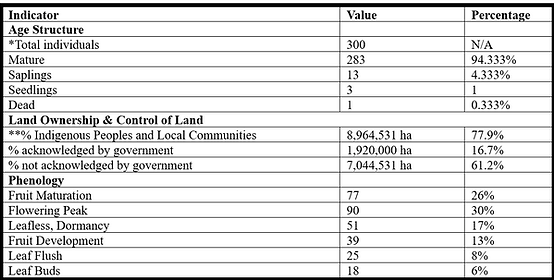
The above stock account shows a population structure strongly dominated by mature trees (94%), with very limited representation of younger individuals. The high proportion of mature trees suggests that the existing baobab population is relatively well established and that adult trees are likely to be resilient to current environmental conditions. However, the very low proportion of seedlings and saplings raises concerns about natural regeneration and long-term population replacement.
Only 16 individuals (approximately 5%) were recorded in the sapling and seedling stages combined, indicating limited recruitment into younger size classes. The phenology account demonstrates that the adult baobab population was predominantly in active reproductive stages, particularly flowering and fruit maturation, while a smaller proportion was undergoing vegetative regeneration or dormancy.
The presence of trees at different phenological stages indicates some degree of variation in the timing of reproductive and vegetative processes. Rainfall patterns, soil moisture availability, temperature, and individual tree characteristics may influence this variation. Given the increasingly irregular rainfall pattern observed across Benin, such climatic variability could affect the timing and success of flowering, fruit development, and leaf production, with potentially greater consequences for seedlings and saplings than for established adult trees.
II). Condition Account

In total, the condition account suggests that established adult baobab trees remain relatively resilient, with 91% classified as medium to high condition and 85% showing no dieback. However, the high prevalence of sparse foliage, defoliation, and leafless canopies indicates that many trees are experiencing seasonal or environmental stress. When considered alongside the earlier stock account—where 94% of individuals were mature trees but only 5% were seedlings and saplings—the findings suggest that adult trees are surviving relatively well, while regeneration and the establishment of younger individuals remain more vulnerable.This distinction is important under the observed rainfall conditions across Benin.
Mature baobabs, with their established root systems and substantial water-storage capacity, are better equipped to withstand periods of moisture stress. Seedlings and saplings, however, have less-developed root systems and are likely to struggle when intense rainfall is followed by prolonged dry periods. Consequently, the main conservation concern may not be immediate mortality of adult trees, but rather poor recruitment and survival of younger trees, which could affect the long-term sustainability of baobab populations.
III). Reproduction Account

The reproductive account suggest that the baobab population was actively reproducing, with flowering and fruit development occurring at substantial levels, but most individuals had not yet progressed to fully mature fruit.
The reproduction account reinforces this pattern through the relatively high proportion of trees with immature pods (36%), although the low proportion of mature pods (1%) indicates that fruit maturation was still incomplete at the time of assessment.
Importantly, these findings should be interpreted alongside the very low proportion of seedlings and saplings in the stock account. The presence of flowering trees and developing fruits demonstrates that the adult population has reproductive capacity, but reproductive activity does not automatically translate into successful regeneration. Low pollination pressure, incomplete fruit maturation, seed germination conditions, and especially the irregular rainfall pattern may all influence the transition from mature fruit to viable seedlings. Thus, adult baobab trees appear capable of reproducing under prevailing conditions, but successful recruitment of seedlings and saplings may remain a bottleneck. The rainfall pattern—characterised by intense rainfall events followed by prolonged dry intervals—may be particularly important at the establishment stage, where young seedlings have limited root systems and are more vulnerable to moisture stress.
IV). Pressure Account

The pressure account indicates that human use and leaf-condition stress as the main pressures affecting the surveyed baobab population, while fire damage was not assessed.
Bark harvesting for human use was recorded for 56 individuals (19%), and visible bark damage occurred on 50 individuals (17%). The close relationship between these two figures suggests that bark harvesting may be an important contributor to physical damage in the population. Although most trees did not show bark damage, the proportion affected is high enough to warrant attention, particularly because repeated or excessive bark removal can compromise tree health and reduce resilience.
The most prominent pressure-related indicators were associated with leaf condition. 126 individuals (42%) had sparse leaves, while 60 (20%) were defoliated. In contrast, only 54 individuals (18%) had full leaves. Therefore, a substantial proportion of the population showed reduced foliage at the time of assessment. This finding is consistent with earlier condition and phenology accounts, which showed considerable leaflessness and dormancy. The reduced foliage may partly represent the natural seasonal cycle of baobab, but it may also reflect water stress associated with irregular rainfall and prolonged dry periods. This distinction matters because mature trees may tolerate these conditions, while younger individuals are more vulnerable. No numerical information was available for fire damage (N/A), so it should not be interpreted as evidence that fire was absent. Rather, fire damage was either not recorded or not applicable in the assessment.
V. Ecosystem Services Account

The ecosystem services results demonstrate that the surveyed baobab population provides several potential benefits to local communities, particularly through fodder and fruit resources. Fodder availability was classified as high for 53 individuals (18%), medium for 45 (15%), and low for 55 (18%).
However, 140 individuals (47%) had no available fodder, while 7 (2%) were non-visible. This indicates that although a considerable proportion of trees can contribute fodder, nearly half of the population did not provide fodder at the time of assessment. This may be influenced by seasonal leaf shedding and the high proportion of trees with sparse or absent foliage.
Potential human use was particularly associated with fruit and fodder. Fruit use was identified for 63 individuals (21%), while fodder use was recorded for 60 (20%). A further 54 individuals (18%) had multiple potential uses, demonstrating that baobabs can provide several ecosystem services simultaneously. In contrast, 116 individuals (39%) had no identified potential human use, while 6 (2%) were non-visible.
Taken together, the results indicate that the baobab population has considerable ecological and livelihood value but faces multiple pressures. Fruit and fodder are important potential resources, while bark harvesting represents a notable form of human pressure. At the same time, the high proportion of trees with sparse foliage or defoliation suggests that environmental stress may be affecting the availability of these services.
The findings are particularly important when considered alongside the previous stock, condition, and reproduction accounts. Adult trees remain relatively resilient and constitute the majority of the population, but there are very few seedlings and saplings. Continued bark harvesting, combined with rainfall variability and moisture stress, could further pressure the population and potentially affect long-term regeneration.
Conclusion
This pilot study shows that Adansonia digitata faces multiple environmental and anthropogenic pressures, with emerging evidence of regeneration constraints not only in West Africa but increasingly across the African continent. The SEEA‑aligned species account proved essential in clarifying the ecological condition of the species, its climate vulnerability, and the demographic pressures shaping long‑term viability. By providing a structured, repeatable framework, the SEEA approach strengthens both present‑day assessments and future climate‑scenario modelling for understanding how A. digitata is likely to respond under changing environmental conditions.
A central finding of this pilot study is the severe imbalance in population structure. Benchmark guidance indicates that healthy regeneration requires at least one seedling, sapling, or juvenile per adult tree (≥1.00:1), while moderate constraints occur when fewer than one juvenile is present per adult (0.50–0.99:1). In contrast, the SEEA Species Stock Account for Benin records 283 adult baobabs and only 16 juveniles, producing a ratio of 1:0.0565. This falls far below the <0.10:1 threshold defining severe regeneration failure, meaning that fewer than six juveniles exist for every hundred adults. The demographic structure is critically imbalanced, and the current population is not producing enough younger individuals to replace mature trees. Without intervention, long‑term population decline is inevitable.
These findings underscore the need for coordinated, continent‑wide action. Benin—and other African countries within the baobab’s range—should undertake comprehensive surveys to establish current regeneration ratios and identify the drivers of recruitment failure. The priority is to rebalance the ratio toward moderate regeneration levels, with a long‑term aim of achieving good to adequate regeneration. Bi-annual SEEA Species Accounts should be adopted to monitor demographic trends, track improvements, and ensure that regeneration deficits are progressively corrected.
Any new trees planted through restoration or community initiatives will require sustained protection, watering, and monitoring, supported by government agencies, local authorities, and community groups. Safeguarding juvenile trees from livestock browsing, fire, and land‑use pressures is essential to ensure survival through the vulnerable early stages.
The study confirms that the SEEA Species Account is the tool for diagnosing ecological condition, identifying regeneration failure, and guiding evidence‑based conservation policy. These results provide a strong foundation for a full‑scale investigation into the regeneration capacity and future persistence of Adansonia digitata in Benin and across Africa.
Acknowledgements
The iNaturalist community of observers (citizen scientists) whose records made this analysis possible, and the GBIF and the GBIF Benin Node.
Competing interest
The author declares that no financial or personal relationship(s) have inappropriately influenced the writing of this article.
References
Abere, M., Yilma, Z., Tsegie, T., Eshete, A. & Alemu, A. (2023). Population structure and phenological attributes of Adansonia digitata L. (Adansonia Digitata) in the Northwestern lowland area of Ethiopia. Heliyon, 9(12). https://doi.org/10.1016/j.heliyon.2023.e22571
Adesina, J. A., & Zhu, J. (2022). A review of the geographical distribution, indigenous benefits and conservation of African baobab (Adansonia digitata L.) tree in sub-Saharan Africa. https://doi.org/10.20944/PREPRINTS202205.0287.V1
Amevivi, A.K., Atakpama, W., Koura, K., Gouwakinnou, N.G., Batawila, K. & Ganglo, J.C. (2025). Spatial distribution and conservation strategy of the Adansonia digitata L. in the conditions of climate change and parasitism by Analeptes trifasciata F. in Togo. Geoinformatica Polonica, 24. https://doi.org/10.4467/21995923gp.25.001.22856
Assogba, D., Idohou, R., Chirwa, P., & Assogbadjo, A. E. (2022). On opportunities and challenges to conserve the African Adansonia Digitata under present and future climates in Benin (West Africa). Journal of Arid Environments, 198, 104692. https://doi.org/10.1016/j.jaridenv.2021.104692
Assogbadjo, A.E., Sinsin, B., Codjia, J.T.C., & Van Damme, P. (2005). Ecological Diversity and Pulp, Seed and Kernal Production of the Baobab (Adansonia Digitata) In Benin. Belgian Journal of Botany, 138(1), 47–56. http://www.jstor.org/stable/20794565
Atakpama, W., Gouwakinnou, G.N., Dimobe, K., Batawila, K., Natta, A.K. & Akpagana, K. (2023). Habitat suitability of subpopulations of Adansonia digitata L. in West Africa: Implications for conservation and domestication. Trees, Forests and People, 12, p.100397. https://doi.org/10.1016/j.tfp.2023.100397
Barnard, P., Altwegg, R., Ebrahim, I. & Underhill, L.G. (2017). Early warning systems for biodiversity in southern Africa–How much can citizen science mitigate imperfect data?. Biological Conservation, 208, pp. 183–188. https://doi.org/10.1016/j.biocon.2016.09.011
Beckage, B., Lavine, M., & Clark, J. S. (2005). Survival of tree seedlings across space and time: estimates from long-term count data. Journal of Ecology, 1177–1184. https://doi.org/10.1111/j.1365-2745.2005.01053.x
Brancalion, P. H., Niamir, A., Broadbent, E., Crouzeilles, R., Barros, F. S., Almeyda Zambrano, A. M., ... & Chazdon, R. L. (2019). Global restoration opportunities in tropical rainforest landscapes. Science advances, 5(7), eaav3223. DOI: 10.1126/sciadv.aav3223
Cancino, X. (2024, June. Concerted Action for the Straw-Coloured Fruit Bat (Eidolon helvum) under the Convention on Migratory Species (CMS).
Chitungo, B., Manyangadze, T. & Ndlela, S. (2022). Potential effects of changes in climate, population density and land use land cover on spatial distribution of Adansonia digitata suitable habitats in Africa. African Journal of Ecology, 60(3), pp.691–701. DOI:10.1111/aje.13008
CHIRPS3 (2026) Climate Hazards Center Infrared Precipitation with Stations version 3 Data Repository: https://doi.org/10.15780/G2JQ0P (2025). Data was accessed in Feb 2026.
Conrad, C.C. & Hilchey, K.G. (2011). A review of citizen science and community‑based environmental monitoring: issues and opportunities. Environmental Monitoring and Assessment, 176, pp.273–291. https://doi.org/10.1007/s10661-010-1582-5
Des Roches, S., Pendleton, L.H., Shapiro, B., Aslan, C.E., Cleland, E.E., Hammond, T.T., Holmes, I., Langerhans, R.B., Marcarelli, A.M., Martinez, C.M., Moore, J.W., Martins, A.G., Schbelen, L.K., Snaydon, S.T., Wolf, J.A. & Palkovacs, E.P. (2021). Conserving intraspecific variation for nature’s contributions to people. Nature Ecology & Evolution, 5(5), pp. 574–582. https://doi.org/10.1038/s41559-021-01403-5
Dhillion, S.S. & Gustad, G. (2004). Local management practices influence the viability of the Adansonia Digitata (Adansonia digitata Linn.) in different land use types, Cinzana, Mali. Agriculture, ecosystems & environment, 101(1), pp.85–103. 10.1016/S0167-8809(03)00170-1
Dogbo, S.F., Salako, K.V., Agoundé, G., Dimobe, K., Adiko, A.E.G., Gebauer, J., Yao, C.Y.A. and Kakaï, R.G., (2025). Potential impacts of future climate on twelve key multipurpose tree species in Benin: Insights from species distribution modeling for biodiversity conservation. Trees, Forests and People, 19, p.100744. DOI:10.1016/j.tfp.2024.100744
Ellegren, H. & Galtier, N. (2016). Determinants of genetic diversity. Nature Reviews Genetics, 17(7), pp.422–433. https://doi.org/10.1038/nrg.2016.58
Eltahir, M.E., El Khalifa, K.F., Taha, M.E., Elamin, H.M. & Adlan, O.S. (2015). Scanty regeneration of baobab (Adansonia digitata) in West Kordofan state, Sudan. Int. J. Agric. For. Fish, 3, pp.206–212.
Fischer, S., Jäckering, L. and Kehlenbeck, K., (2020). The Adansonia Digitata (Adansonia digitata L.) in southern Kenya–a study on status, distribution, use and importance in Taita–Taveta County. Environmental Management, 66(3), pp.305–318. https://doi.org/10.1007/s00267-020-01311-7
Funk, C., Peterson, P., Harrison, L. et al. The Climate Hazards Center Infrared Precipitation with Stations, Version 3. Sci Data 13, 718 (2026). https://doi.org/10.1038/s41597-026-07096-4
Gadallah, N., Gone, B., Hakam, O., et al. (2025). Modelling the impacts of climate change on the current and future distribution of Adansonia Digitata (Adansonia digitata L.) in Sudan. Model. Earth Syst. Environ. 11, 404 . https://doi.org/10.1007/s40808-025-02574-x
Gallagher, R., Roger, E., Packer, J., Slatyer, C., Rowley, J., Cornwell, W., ... & Mesaglio, T. (2025). Incorporating citizen science into IUCN Red List assessments. Conservation Biology, 39(2), e14329. DOI: 10.1111/cobi.14329
Gebauer, J., Luedeling, E. (2013). A note on baobab (Adansonia digitata L.) in Kordofan, Sudan. Genet Resour Crop Evol 60, 1587–1596. https://doi.org/10.1007/s10722-013-9964-5
Gijsbers, H.J.M., Kessler, J.J. & Knevel, M.K. (1994). Dynamics and natural regeneration of woody species in farmed parklands in the Sahel region (Province of Passore, Burkina Faso). Forest Ecology and Management, 64(1), pp.1–12. http://dx.doi.org/10.1016/0378-1127(94)90122-8
Grandjean, T., Arroyo-Rodríguez, V., Núñez-Farfán, J. and Martínez-Ramos, M., (2026). Forest-to-agriculture conversion drives collapse of regenerative and adult tropical tree communities—Biological Conservation, 313, p.111624.
Kamins, A.O., Restif, O., Ntiamoa-Baidu, Y., Suu-Ire, R., Hayman, D.T.S., Cunningham, A.A., Wood, J.L.N. & Rowcliffe, J.M. (2011). Uncovering the fruit bat bushmeat commodity chain and the true extent of fruit bat hunting in Ghana, West Africa. Biological Conservation, 144(12), pp. 3000–3008. https://doi.org/10.1016/j.biocon.2011.09.003
Khwilimba, G., Swanepoel, L.H. & Venter, S.M. (2026). The involvement of community members significantly increases the success of tree planting projects–a case study of Adansonia Digitata (Adansonia digitata L.) planting, South Africa. Trees, Forests and People, p.101254.
LandMark: The Global Platform of Indigenous and Community Lands. (2025). https://doi.org/10.1016/j.tfp.2026.101254
Lange, G.-M., & Herrera, D. (2018). Land assets, climate change, and degradation impacts. In World Bank, The changing wealth of nations 2018: Building a sustainable future (pp. 129–158). World Bank. https://doi.org/10.1596/978-1-4648-1046-6
Lisao, K., Geldenhuys, C.J. & Chirwa, P.W. (2018). Assessment of the African baobab (Adansonia digitata L.) populations in Namibia: Implications for conservation. Global Ecology and Conservation, 14, p.e00386. DOI:10.1016/j.gecco.2018.e00386
Löf, M., Madsen, P., Metslaid, M., Witzell, J., & Jacobs, D. F. (2019). Restoring forests: regeneration and ecosystem function for the future. New Forests, 50(2), 139–151. https://doi.org/10.1007/s11056-019-09713-0
Lokonon, B.E., Gbemavo, C.D., Sodote, F.E., Manda, L., Kakaï, R.G. & Sinsin, B. (2022). Effect of provenance on population structure and regeneration of six multiple-use tree species along Ouémé catchment in Benin: Implications for conservation. Trees, Forests and People, 7, p.100206. https://doi.org/10.1016/j.tfp.2022.100206
Mable, B.K. (2019). Conservation of adaptive potential and functional diversity: integrating old and new approaches. Conservation Genetics, 20(1), pp.89–100. DOI:10.1007/s10592-018-1129-9
Maxwell, S.L., Cazalis, V., Dudley, N., Hoffmann, M., Rodrigues, A.S., Stolton, S., Visconti, P., Woodley, S., Kingston, N., Lewis, E. & Maron, M. (2020). Area-based conservation in the twenty-first century. Nature, 586(7828), pp.217–227. https://doi.org/10.1038/s41586-020-2773-z
Mayne, D.H., Karimi, N., Cruywagen, E.M., Cole. P., & Goodall, V. (2022). Baobab at the edge: 90-year dynamics of climate variability, growth, resilience, and evolutionary legacy effects. Frontier in Forests and Global Change, 5, Article 1036636. https://doi.org/10.3389/ffgc.2022.1036636
Mpofu, E., Gandiwa, E., Zisadza-Gandiwa, P. and Zinhiva, H., (2012). Abundance, distribution and status of African baobab (Adansonia digitata L.) in dry savanna woodlands in southern Gonarezhou National Park, southeast Zimbabwe. Tropical Ecology, 53(1), pp.119-124.
Msalilwa, U., Ndakidem, P., Makule, E. & Munishi, L. (2020). Demography of baobab (Adansonia digitata L.) population in different land uses in the semi-arid areas of Tanzania. https://doi.org/10.1016/J.GECCO.2020.E01372
Munyebvu, F., Mapaure, I. & Kwembeya, E.G. (2018). Abundance, structure and uses of Baobab (Adansonia digitata L.) populations in Omusati Region, Namibia. South African Journal of Botany, 119, pp.112–118. DOI:10.1016/j.sajb.2018.08.020
Nzengya, D., & Mutasa, K. (2007). Environmental perceptions and attitudes of local communities towards sustainable harvest of the baobabs (Adansonia digitata), Zimbabwe [Paper presentation]. 1st Global Workshop on Improving Forestry Education, World Agroforestry Centre, Nairobi, Kenya.
Pielke, Roger and Ritchie, Justin, Systemic Misuse of Scenarios in Climate Research and Assessment (2020). Available at SSRN: https://ssrn.com/abstract=3581777 or http://dx.doi.org/10.2139/ssrn.3581777
Sanchez, A.C. (2011). The baobab tree in Malawi. Fruits, 66(6), pp.405–416. https://doi.org/10.1051/fruits/2011055
Scotti, I., González-Martínez, S.C., Budde, K.B. and Lalagüe, H., (2016). Fifty years of genetic studies: what to make of the large amounts of variation found within populations? I. Scotti et al. Annals of Forest Science, 73(1), pp.69–75. DOI 10.1007/s13595-015-0471-z
Sidibe, M., & Williams, J. T. (2002). Baobab, Adansonia digitata L. (Vol. 4). International Centre for Underutilised Crops. ISBN 0854327762.
Stange, M., Barrett, R.D. and Hendry, A.P., (2021). The importance of genomic variation for biodiversity, ecosystems and people. Nature Reviews Genetics, 22(2), pp.89–105. https://doi.org/10.1038/ s41576-020-00288-7
Tagliari, M.M., Danthu, P., Leong Pock Tsy, J.M., Cornu, C., Lenoir, J., Carvalho‐Rocha, V. and Vieilledent, G., (2021). Not all species will migrate poleward as the climate warms: The case of the seven Adansonia Digitata species in Madagascar. Global Change Biology, 27(23), pp.6071–6085. DOI: 10.1111/gcb.15859
Tsegay, H.W. (2026). Population Structure and Regeneration Dynamics of Balanites aegyptiaca Tree Species in the Farmlands of Western Tigray, Ethiopia. International Journal of Forestry Research, 2026(1), p.7269838.UNEP-WCMC (2016). Exploring approaches for constructing Species Accounts in the context of the SEEA-EEA. DOI:10.1155/ijfr/7269838
UNEP-WCMC (2016). Exploring approaches for constructing Species Accounts in the context of the SEEA-EEA
Venter, S. M., & Witkowski, E. T. (2019). Phenology, flowering and fruit-set patterns of baobabs, Adansonia digitata, in southern Africa. Forest Ecology and Management, 453, 117593. 10.1016/j.foreco.2019.117593
Venter, S.M. and Witkowski, E.T.F., (2013). Where are the young Adansonia Digitatas? Factors affecting regeneration of Adansonia digitata L. in a communally managed region of southern Africa. Journal of Arid Environments, 92, pp.1–13. https://doi.org/10.1016/j.jaridenv.2012.12.010
Vickers, L. A., McWilliams, W. H., Knapp, B. O., D'Amato, A. W., Saunders, M. R., Shifley, S. R., ... & Westfall, J. A. (2019). Using a tree seedling mortality budget as an indicator of landscape-scale forest regeneration security. Ecological Indicators, 96, 718–727. 10.1016/j.ecolind.2018.06.028